Based on in-depth research in all aspects.



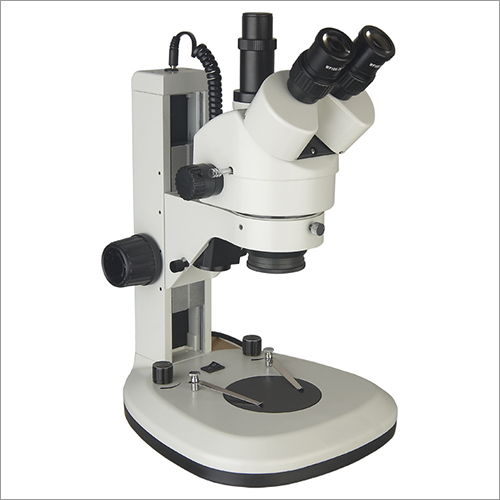
Stereo Zoom Microscopes
Product Details:
- View Head Binocular head
- Spare Parts Eyepiece pair, glass stage plate, objective lens, power adapter
- Focus System Rack and pinion, vertical movement
- Features Universal stand, LED illumination, wide field eyepieces, ergonomic design, zoom magnification
- Theory Stereo Zoom Microscopes provide high-quality three-dimensional images with high resolution and a wide field of view. These microscopes are ideal for inspection, dissection, and precision work in laboratories and industrial applications.
- Drawtube Binocular
- Sensor Not Applicable (Optical viewing)
- Click to View more
X
Stereo Zoom Microscopes Price And Quantity
- Provided on one or both eyepiece tubes for individual focusing
- 360 rotatable binocular head for flexible viewing positions
- 220V AC/50Hz or 110V AC/60Hz
- 200 mm x 250 mm
- Approx. 6 kg
- Provided for specimen holding
- Supports 0.5x, 1.5x, and 2x auxiliary objectives (optional)
- Education, research, electronics inspection, dissection, gemology
- Anti-rust enamel coated body
Stereo Zoom Microscopes Product Specifications
- Built-in LED illumination, both reflected and transmitted
- Depends on camera; not included by default
- High optical resolution, varies by selected objective/eyepiece combination
- Universal stand, LED illumination, wide field eyepieces, ergonomic design, zoom magnification
- Depends on camera; not included by default
- Adjustable, 55 mm to 75 mm
- Incident and transmitted LED illumination
- Frosted glass stage plate with black & white contrast plate
- Not Applicable (Optical viewing)
- Up to 50 mm
- Inclined at 45, rotatable 360
- Stereo Zoom Microscopes provide high-quality three-dimensional images with high resolution and a wide field of view. These microscopes are ideal for inspection, dissection, and precision work in laboratories and industrial applications.
- Rack and pinion, vertical movement
- Variable, typically 100 mm
- Not applicable unless digital camera attached
- Eyepiece pair, glass stage plate, objective lens, power adapter
- Manual coarse focusing, adjustable
- Manual operation; Camera port optional
- Binocular
- Zoom objective 0.7x to 4.5x, achromatic optics
- Zoom range 7x to 45x (Total magnification with auxiliary objectives and eyepieces may vary)
- Binocular head
- Approx. 300 mm x 200 mm x 400 mm (L x W x H)
- Not applicable (optical viewing); Camera port supports digital format when adapted
- Wide Field 10x (pair)
- Provided on one or both eyepiece tubes for individual focusing
- 360 rotatable binocular head for flexible viewing positions
- 220V AC/50Hz or 110V AC/60Hz
- 200 mm x 250 mm
- Approx. 6 kg
- Provided for specimen holding
- Supports 0.5x, 1.5x, and 2x auxiliary objectives (optional)
- Education, research, electronics inspection, dissection, gemology
- Anti-rust enamel coated body
Product Description
Driven by technical excellence, we are counted as the topmost importer and supplier of excellent quality range of Stereo Zoom Microscopes. These are designed for low magnification observation of a sample in labs. Under the observation of our team, these are manufactured in line with set industry standards using quality-approved materials. Moreover, our prestigious clients can avail these Stereo Zoom Microscopes in several technical specifications.
Features:
- Robust construction
- Digital temperature indicator
- Accurate measurement
Trinocular Stereo Zoom Microscope with transmitted light & Incident light.
| Magnification | 7X to 45 (field of view: 36mm - 2.1mm) |
| Auxiliary Lens | 0.32x |
| Zoom Range | 0.7X - 4.5X |
| Eyepiece | Wide field 10x (WFH10X) |
| Working Distance | 100 mm |
| Inter pupillary Distance | 55mm to 75mm |
| Diopter Adjustment | 4.3 D on + ~-5 diopter vertical tube |
| Stand Type | Fan style base & track stand with HF with coarse and fine focusing hand wheel |
| Incident Light | 6V / 15W Halogen |
| Transmitted | Fluorescent lamp 5 W |
| Accessories | Rubber eye guards, Tension control pin |
360 Rotatable Binocular Head
The fully 360 rotatable binocular head permits users to position the microscope at any angle, promoting ergonomic comfort and enhancing shared use during group sessions or multidisciplinary tasks. Combined with its 45 inclined eyepiece tubes and adjustable interpupillary range, it reduces neck strain during prolonged observations.
Versatile Illumination and Stage Design
Built-in LED incident and transmitted illumination ensures clear visualization of both opaque and transparent specimens. The frosted glass stage plate, with a black & white contrast plate and secure stage clips, provides stable specimen support for a wide array of applications, from biological dissection to microelectronics inspection.
Precision Optics and Flexible Magnification
Featuring a zoom objective (0.7x4.5x, achromatic), this microscope offers high-resolution imaging across a broad zoom range (7x45x standard). Compatibility with auxiliary objectives (0.5x, 1.5x, 2x) and wide field eyepieces allows further customization, adapting magnification and field of view to precise task requirements.
FAQs of Stereo Zoom Microscopes:
Q: How does the 360 rotatable head enhance usability during microscopy sessions?
A: The 360 rotatable binocular head allows the microscope to be easily repositioned for optimal comfort or to accommodate multiple viewers. This flexibility reduces strain on the users neck and back, making extended observation more comfortable, especially during collaborative work or demonstrations.Q: What are the benefits of diopter adjustment on the eyepiece tubes?
A: Diopter adjustment enables individual focusing for each user, compensating for differences in vision between the eyes. This ensures a sharp and clear image during prolonged use, minimizing eye fatigue and delivering precise results across varied user groups.Q: When should auxiliary objectives be used with this stereo zoom microscope?
A: Auxiliary objectivesavailable in 0.5x, 1.5x, and 2x magnificationscan be used when specific magnification ranges or working distances are required. They are particularly useful when inspecting larger samples or needing enhanced detail, allowing tailored magnification for different tasks.Q: Where is this microscope typically applied, and what fields benefit most from its features?
A: This stereo zoom microscope sees extensive use in educational settings, biological research, electronics inspection, dissection, and gemology. Its adjustable optics, expansive working distance, and sturdy anti-rust build make it especially suited to laboratories, industrial facilities, and academic environments.Q: How is the illumination system configured for diverse specimen types?
A: The microscope is equipped with both incident (reflected) and transmitted LED illumination, allowing it to accommodate opaque as well as transparent specimens. Users can adjust lighting modes to optimally highlight features, facilitating comprehensive specimen analysis in varied applications.Q: What is the process for switching magnification or objectives?
A: Users can quickly adjust magnification using the variable zoom knob, which smoothly transitions between 7x and 45x. For further customization, auxiliary objectives are mounted onto the objective lens area, instantly modifying the zoom range and working distance as needed for specific observation tasks.Tell us about your requirement

Price:
Quantity
Select Unit
- 50
- 100
- 200
- 250
- 500
- 1000+
Additional detail
Mobile number
Email

Other Products in 'Professional Microscope' category


QS METROLOGY PVT. LTD.
Delhi, India
Delhi, India

Address
- PLOT NO.49, PHASE - IV, SECTOR-8, IMT MANESAR, Gurugram - 122050, Haryana, India

Contact Number
- Phone : 08045800532

Key Personnel
- Mr Bob Albin (Director)
- Mobile : 08045800532
- Send Inquiry
 Send Inquiry
|

|
 |
QS METROLOGY PVT. LTD.
All Rights Reserved.(Terms of Use) Developed and Managed by Infocom Network Private Limited. |
