Based on in-depth research in all aspects.




Dimensional Metrology
Product Details:
X
Product Description
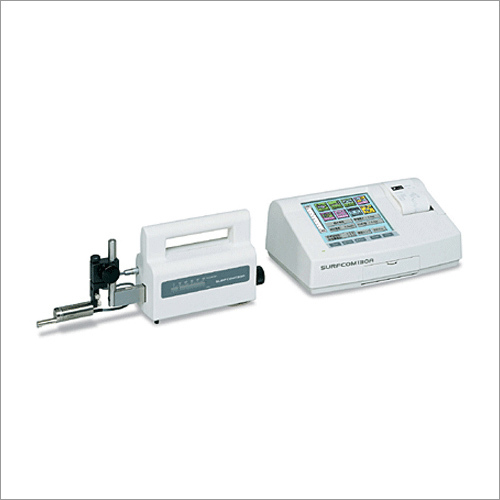
Dimensional MetrologyWe are into the business of producing and supplying the top quality range of Surface Roughness Tester which quantifies surface of metal and non-metal parts. Due to its little and smaller size, it can be transported easily and effortlessly anywhere. The computerized reasoning capacities naturally select the perfect cut off quality, measuring range and different conditions. It is easy to understand and bolsters extensive variety of styli alternatives.
Remarkable attributes:
- Top Flight Performance in ProductionBest of class Straightness Accuracy 0.3um/50 mm
- Easy Change of Stylish
- 50 mm navigate length, worked in datum plane and substantial measuring range
- Wide Range of styli alternatives identifier
- Handy, minimal use
- Analysis parameters obliging overall prerequisites
- Selectable Amplifier LCD touch board
- Artificial Intelligence works consequently select the perfect cut off quality, measuring range and different conditions. This robotizes estimation.
- PC Card Slot-Measuring Conditions, Measured result administration or measured information can be yield in parallel and content configuration.
- Host of Analysis Functions-joins 34 sorts of unpleasantness and 32 waviness parameters.
- Tilt Correction Function: Six kind of programmed tilt adjustment are given.
- Evaluation Range Setting-The waveform on the screen is encased by two cursors, permitting the fancied extent to be set and the parameters to be figured.
Specifications:
Measuring Range: X Axis- 50mm, Z axis - 800 mm (Measuring range resolution: 800m/10nm, 80m/1nm, 8 m/0.1nm)
Straightness accuracy: 0.3m/50mm
Analysis items:
Standards: Complies with JIS-2001, JIS-1994, JIS-19822, ISO- 1997, ISO-1984, DIN-1990, ASME-1995, and CNOMO.
Parameters: Ra, Rq, Ry, Rp, Rv, Rc, Rz, Rmax, Rt, Rz,J, R3z, Sm, S, R ?a, R ?q, R ?a, R ?q, TILT A, Ir, Pc, Rsk, Rkpk, Rvk, Mr1, Mr2, VO, K, tp, Rmr, Tp2, Rmr2, R dc, AVH, Hmax, Hmin, AREA, NCRX, R, Rx, AR, NR, CPM, SR, SAR
Evaluation curves: Section profile curve, filtered waviness curve, filtered center line waviness curve, rolling circle waviness curve, rolling circle center line waviness curve, DIN4776 special curve, roughness motif curve, envelope waviness curve
Surface Characteristics graphs: Bearing area, curve, amplitude distribution (ADF) curve, power graph
TILT Correction: Linear correction, first half correction, latter half correction, both end correction, spline curve correction
Magnification : Vertical (Z-axis)- 50-100K Auto, Horizontal (X-axis): 1-5K auto
Detector : Tip radius 2m, material diamond
Special functions: Artificial Intelligence functions, step analysis, PC card
Standard Accessories: Standard specimen, Recording Paper, Touch Pen, Instruction Manual
Exceptional Accuracy and Precision
Deliberately engineered with high-precision mechanics and electronics, these metrology tools ensure measurements are accurate to within 0.001 mm. Their robust calibration and fine adjustment features enable reliable results, crucial for critical industrial and laboratory applications.
Versatile Product Range and Packaging
Available in measuring ranges from 0-150 mm up to 0-1000 mm, the instruments accommodate a spectrum of measurement needs. Packaged in sturdy plastic or wooden cases, they remain protected during storage and transportation, extending lifespan and maintaining quality integrity.
Durability and User-Friendly Design
Manufactured from corrosion-resistant stainless steel and hardened alloy, these tools are built for long-term use. Their ergonomic design includes locking screws and fine adjustments, facilitating hassle-free and effective operation for both analog and digital measurement tasks.
FAQs of Dimensional Metrology:
Q: How do I use this dimensional metrology tool for precise measurements?
A: To operate, select the proper measuring range, ensure the instrument is calibrated, and use fine adjustments for accuracy. Place the object securely and utilize the locking screw before reading results from the analog or digital display.Q: What advantages does the corrosion-resistant finish provide?
A: The corrosion-resistant finish protects the instrument against rust and wear, ensuring consistent accuracy and a longer service life in both industrial and laboratory environments.Q: When should I recalibrate my metrology instrument?
A: It is recommended to recalibrate after significant usage intervals, major impact, or exposure to extreme environments. Regular calibration also aligns with industrial quality standards and is supported by the certification provided.Q: Where can I purchase or source these tools in India?
A: These dimensional metrology instruments are available through authorized distributors, importers, manufacturers, and suppliers across India, ensuring easy access for various industrial and laboratory requirements.Q: What materials are used in manufacturing this measuring equipment?
A: The tools are made from stainless steel and hardened alloy, delivering durability, resistance to environmental factors, and maintaining high precision over time.Q: What is the benefit of having both analog and digital display options?
A: Analog displays offer visual clarity for traditional users, while digital displays provide direct numerical readings, reducing possible human error and enhancing measurement reliability.Tell us about your requirement

Price:
Quantity
Select Unit
- 50
- 100
- 200
- 250
- 500
- 1000+
Additional detail
Mobile number
Email

Other Products in 'Dimensional Metrology Equipment' category

QS METROLOGY PVT. LTD.
Delhi, India
Delhi, India

Address
- PLOT NO.49, PHASE - IV, SECTOR-8, IMT MANESAR, Gurugram - 122050, Haryana, India

Contact Number
- Phone : 08045800532

Key Personnel
- Mr Bob Albin (Director)
- Mobile : 08045800532
- Send Inquiry
 Send Inquiry
|

|
 |
QS METROLOGY PVT. LTD.
All Rights Reserved.(Terms of Use) Developed and Managed by Infocom Network Private Limited. |
